If you are transferring an employee from an overseas office to a U.S. branch, one of the first questions you will run into is which L-1 category actually applies, and what kind of documentation supports it. The answer shapes almost everything that follows, including the type of L1 business plan your case will need.
Many applicants assume any generic company overview will satisfy USCIS. In reality, a proper l1 business plan is built around the specific classification you are filing under. An L-1A plan and an L-1B plan are not interchangeable, and using the wrong structure can weaken an otherwise strong petition.
What Is the L-1 Visa Category?
The L-1 visa allows a multinational company to transfer certain employees from a foreign office to a related U.S. office. It exists specifically for intracompany transferees, meaning the U.S. and foreign entities must share a qualifying relationship, such as parent, subsidiary, branch, or affiliate.
Within this single visa category, USCIS recognizes two distinct classifications. Understanding which one applies to your employee is the first step before any business plan is drafted.
L-1A vs L-1B: Understanding the Difference
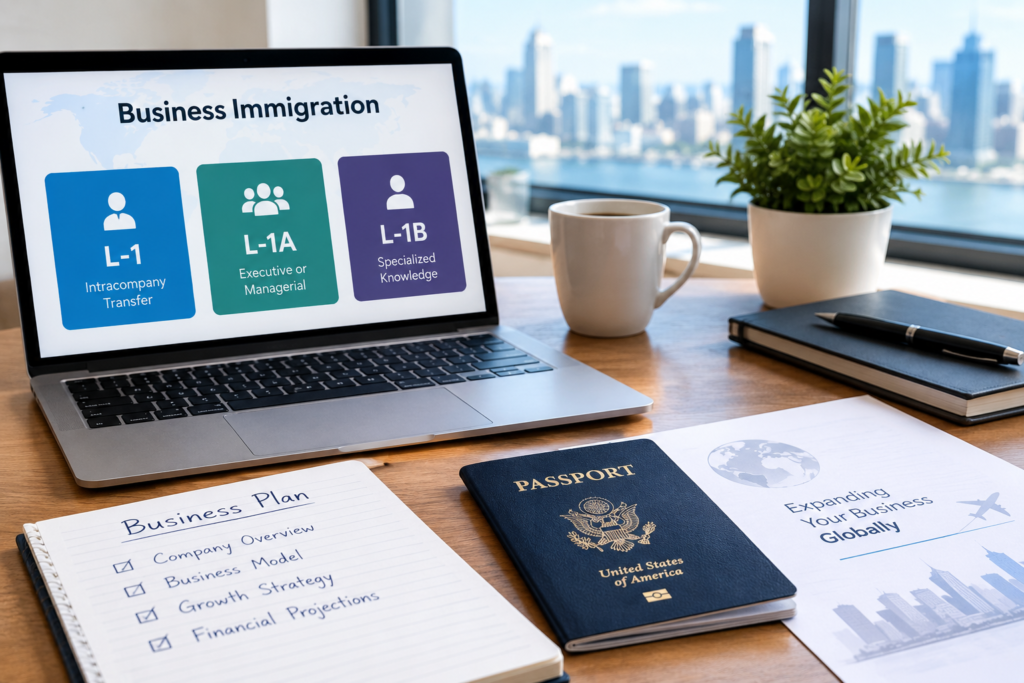
The L-1A and L-1B classifications exist for two very different types of employees, and each one requires the business plan to prove a different set of facts.
L-1A: Executives and Managers
The L-1A classification applies to employees who will work in the U.S. in an executive or managerial capacity. This means the person directs the organization, manages a department or function, supervises other employees, or has significant decision-making authority over daily operations.
For a new office petition, the L-1A business plan must show that the U.S. entity will be staffed and structured enough to genuinely support an executive or managerial role within a reasonable timeframe. Without a credible growth trajectory, it becomes difficult to justify why a manager is needed at all.
L-1B: Specialized Knowledge Employees
The L-1B classification is for employees who possess specialized knowledge of the company’s products, services, research, equipment, techniques, or management. This knowledge must go beyond what is ordinarily found in the industry and must be tied directly to the petitioning organization.
An L-1B business plan takes a different approach. Instead of emphasizing organizational hierarchy, it needs to explain how the specialized knowledge will be applied within U.S. operations and why that expertise is essential to the business functioning as planned.
Why the Business Plan Cannot Be One-Size-Fits-All
At Legacy Business Plans, we prepare L-1A and L-1B business plans with different priorities based on the specific requirements of each classification. A plan written for a manager transfer will not hold up the same way for a specialized knowledge transfer, and vice versa.
This distinction becomes especially important for new office petitions, where the U.S. entity has limited operating history. In these cases, immigration officers are looking closely at whether the business, staffing, and finances described in the plan are realistic and specific to the role being filed.
Why L-1A Petitions Need a Growth-Focused Business Plan
An L-1A new office petition has to demonstrate that within one year, the U.S. office will support an executive or managerial position. That is a specific, testable claim, and the business plan carries most of the weight in proving it.
This typically means the plan should include a staffing timeline that shows when and how additional employees will be hired, an organizational chart reflecting the proposed manager’s position, and financial projections that support the payroll and operating costs tied to that growth. Job descriptions for both the transferring employee and future hires help reinforce that the managerial role is not created on paper alone.
Why L-1B Petitions Need a Knowledge-Focused Business Plan
An L-1B business plan has a different job to do. Rather than building a growth story around staffing, it needs to connect the employee’s specialized knowledge to concrete business operations, such as a proprietary process, a technical system, or a service delivery method that only this employee can properly execute or transfer to the U.S. team.
The plan should also outline how that knowledge supports the company’s immigration business plan strategy as a whole, including how operations, training, and any knowledge transfer to U.S. staff will unfold over time. Financial projections still matter, but they support the operational story rather than driving it.
What a Well-Prepared L1 Business Plan Typically Includes
Regardless of classification, most L1 business plans are expected to contain a core set of components, adjusted based on whether the case is L-1A or L-1B.
- Executive summary outlining the U.S. business and its purpose
- Overview of the qualifying relationship between the U.S. and foreign entities
- Organizational structure and staffing plan
- Job descriptions for the transferring employee and any additional hires
- Market and industry analysis
- Marketing and operational strategy
- Multi-year financial projections, including revenue, expenses, and cash flow
- Milestones table showing planned business developments over time
These sections should not read as generic filler. Every part of the plan needs to point back to why this specific classification and this specific employee are necessary for the U.S. operation to function.
Common Mistakes Applicants Make
A recurring issue in weaker petitions is using the same business plan template for both L-1A and L-1B filings, simply swapping the employee’s name and title. This usually results in a document that lists managerial duties for a specialized knowledge case, or specialized knowledge language for a managerial case, and neither version holds up well under review.
Another common mistake is submitting financial projections that are disconnected from the staffing plan or job descriptions. If the numbers do not match the narrative, it raises more questions than it answers. A tightly aligned plan, where staffing, finances, and job functions all tell the same story, tends to hold up far better.
Choosing the Right Business Plan for Your Case
Before deciding which type of plan to prepare, it helps to confirm which classification your employee actually qualifies for, since that decision drives the entire document. This is typically done in consultation with an immigration attorney who reviews the employee’s role, responsibilities, and the relationship between the two entities.
Once the classification is confirmed, the business plan can be built around the specific requirements of that category, rather than trying to cover both possibilities at once. This targeted approach tends to produce a clearer, more persuasive document for USCIS review.
Final Thoughts
Choosing between an L-1A and L-1B business plan comes down to understanding what the classification is actually asking you to prove. An executive or managerial transfer calls for a growth-oriented plan, while a specialized knowledge transfer calls for an operationally focused one.
Getting this distinction right from the start can make the difference between a business plan that simply describes the company and one that directly supports the petition it was written for. If you are preparing for an L-1A or L-1B filing and want a business plan built around your specific classification, contact us to discuss your case.
Frequently Asked Questions
No. An L-1A business plan focuses on staffing growth and organizational structure to support a managerial or executive role, while an L-1B business plan focuses on how the employee’s specialized knowledge will be applied within U.S. operations.
Not every L-1 case requires the same level of documentation, but new office petitions and smaller companies typically need a detailed business plan to demonstrate viability, since they lack the extensive operating history that larger multinational companies may have.
It is possible if a company is transferring employees under both classifications at the same time, but each employee’s role within the plan should still be addressed separately, with distinct job descriptions and justifications for each classification.
Length varies by case complexity, but most L1 business plans run long enough to fully cover the qualifying relationship, staffing plan, market analysis, and multi-year financial projections without unnecessary padding.
Using the wrong framework can create inconsistencies between the petition and the supporting business plan, which may lead to requests for additional evidence or a weaker overall case.